For a long time, annual tariff reviews in logistics followed a familiar script. A letter. A percentage. A polite explanation. And then… business as usual.
That script doesn’t really work anymore.
Across shipping, clearing, road freight and port services, annual reviews have become more detailed, more scrutinised and, frankly, more uncomfortable on both sides of the table. Not because logistics providers suddenly want to charge more — but because the cost structure underneath logistics has fundamentally changed.
Let’s unpack what’s happening.
Then vs now: how annual increases used to work
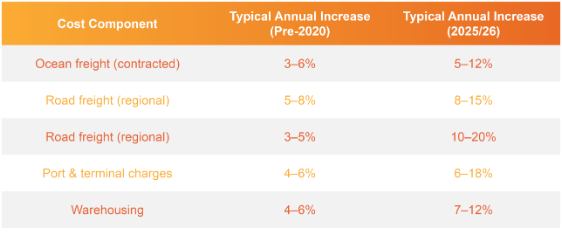
Historically, annual logistics increases were modest, predictable and largely inflation-linked. In many Southern African contracts, increases sat comfortably in the 4–7% range, often applied as a single blanket uplift across services.
Fuel spikes, port congestion or regulatory changes were treated as exceptions, not structural realities. That’s no longer the case.
What increases look like today
Today’s reviews reflect a far more complex operating environment. Instead of one neat percentage, costs are moving at different speeds — and not all of them are within a logistics provider’s control.
Why is this happening
Fuel volatility has shifted from being an exception to something that needs to be actively managed. Many operators now use indexed fuel mechanisms instead of fixed assumptions, improving fairness but also increasing visibility.
Port costs continue to rise as infrastructure, security and environmental compliance expenses are passed through to users. These are not discretionary costs.
Compliance and documentation requirements have increased significantly, particularly in customs and cross-border trade, placing pressure on clearing and administrative functions.
Your logistics provider should be making these annual reviews easier to manage
Annual tariff reviews don’t have to feel like a once-a-year shock to the system. When they’re handled properly, they should actually make your logistics planning simpler, not harder.
A good logistics partner should help by explaining what’s changed in plain language, separating what’s variable from what’s stable, and using mechanisms instead of surprises.
They should help you plan by giving context around what’s likely to stay stable, what could change, and where the real risks sit for your specific trade lanes or cargo types.
Even when certain costs sit outside their control, your logistics provider should own the explanation and make those costs easier to understand and manage.
When logistics providers take this approach, tariff reviews stop being about defending increases and start becoming part of smarter supply chain planning.
Talk to us about how we can support you in navigating annual tariff reviews. We focus on transparency, practical structures and fewer surprises, even in volatile conditions.